


Headcount is no longer a vanity metric. It is an efficiency test.
If you built your team in 2021 or 2022, your org chart is likely a liability.
If you walk into a VC pitch today with 2021-era headcount ratios, you aren't signaling growth. You are signaling that you haven't figured out how to use modern leverage.
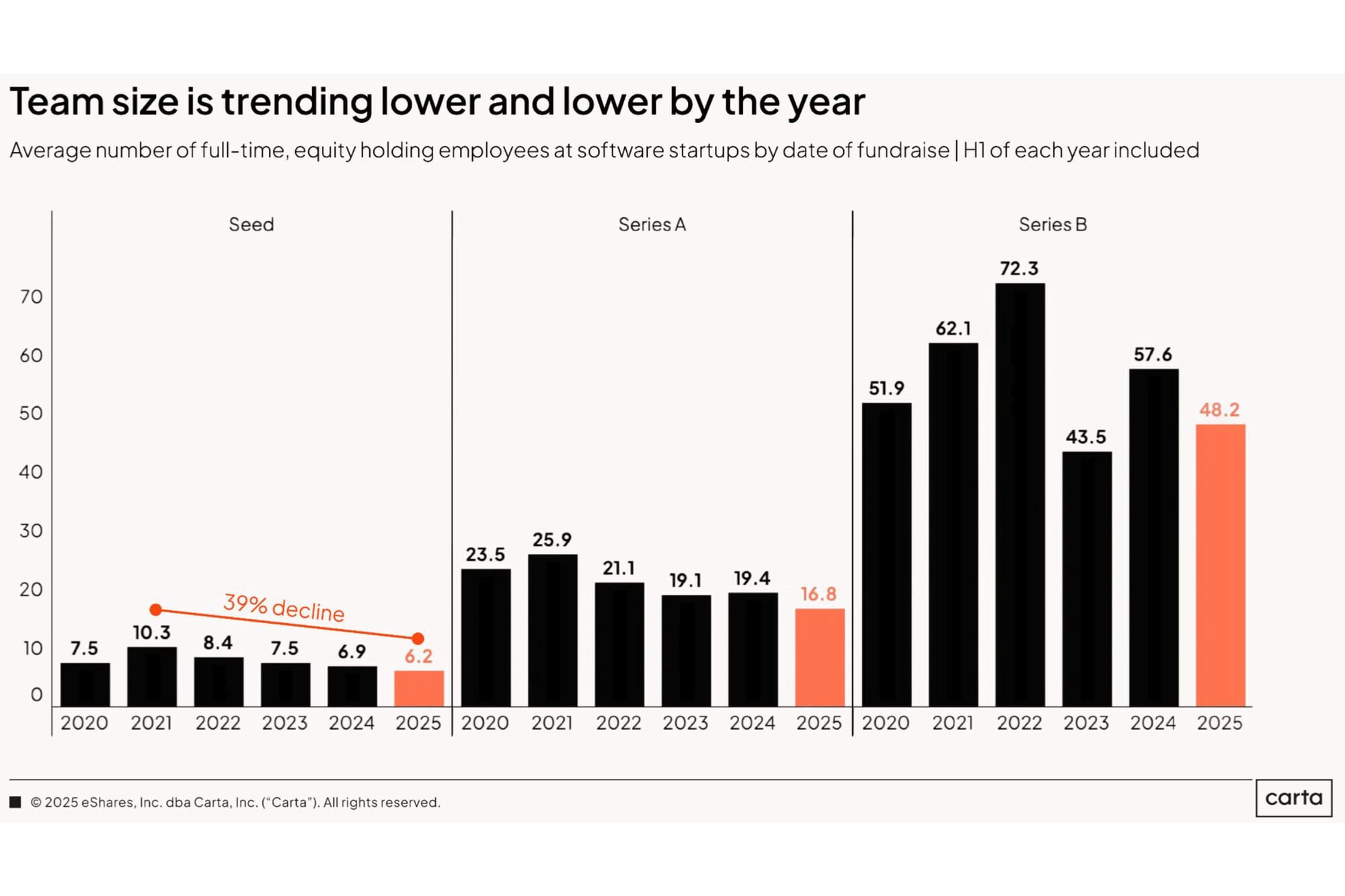
The chart above from Carta reveals a dramatic fall in team sizes.
Compare the average headcount from 2021 to 2025:
📉 Seed Stage: Down ~40% (10.3 → 6.2 employees)
📉 Series A: Down ~35% (25.9 → 16.8 employees)
📉 Series B: Down ~22% (62.1 → 48.2 employees)
This is not the reflection of a capital crunch. It is a technological reset.
Investors have priced "AI leverage" into their expectations. They assume your engineering team uses Claude Code or Cursor. They expect that your support team uses agents. They believe that your ops layer should be automated.
If you have 25 people doing the work that a modern 15-person team can do, you are paying an "inefficiency tax."
You need to right-size your org to 2025 standards before you try to raise your next round of funding.
There are three steps you should take right now:
🧠 Install AI-first leadership.
You cannot build a lean company with leaders who fear automation. If your leadership team sees AI as a threat to their job security rather than a tool, they are a bottleneck. You need leaders willing to dismantle the empires they built. Disrupt yourself, or be disrupted by a nimble upstart.
🔍 Audit legacy roles and processes.
Once you have the right leadership, ignore the sunk cost fallacy. Just because a team exists doesn't mean it should. Look at every manual workflow. If a process can be automated, the role attached to it might be obsolete. Rethink everything.
✂️ Restructure before the pitch.
Do not wait for a VC to tell you your revenue-per-headcount is too low. If you pitch with a bloated team, you will get passed over. Make the hard decisions now. Show a quarter of efficient metrics before you ask for the check.
None of this is easy for a founder.
Hiring employees and growing teams feels like progress. Reducing headcount feels like failure.
But we need to flip these misconceptions on their head.
We can also recognize that this data is the tip of the spear for a massive disruption in the broader labor market. We are looking at a future with structurally fewer jobs in knowledge work. That is a difficult societal reality to process.
But you cannot solve the macro labor crisis by running an inefficient business.
As a founder, your priority is build a successful startup that can hit its milestones, attract the funding it needs to survive, and fully realize your vision.
Right now, that means doing more with less.


